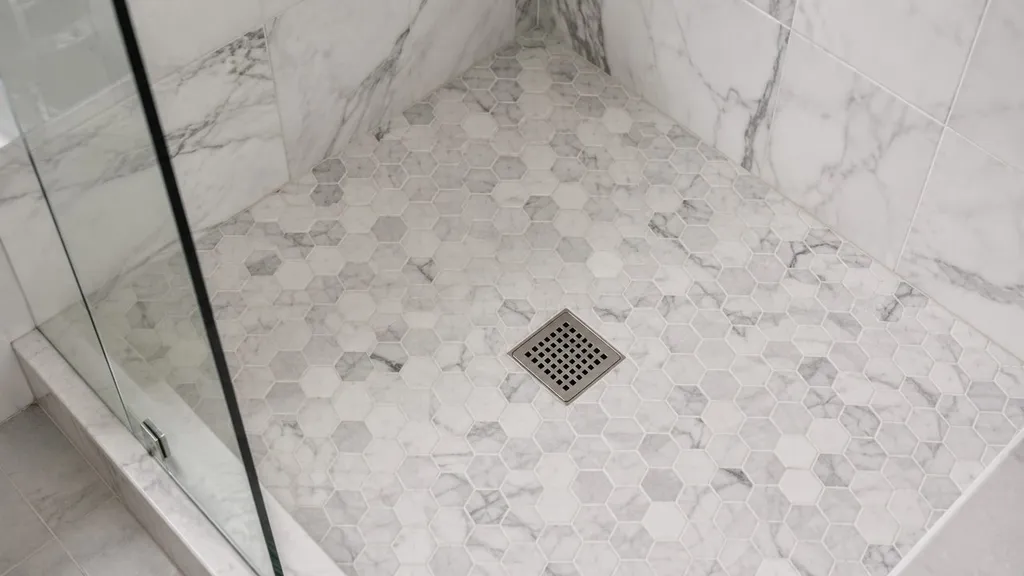
A shower floor occupies only a small percentage of a bathroom, yet choosing the wrong material can affect the entire space. It has to look right, work with the slope toward the drain, handle regular exposure to water, feel comfortable underfoot, and complement the surrounding walls.
That is a surprisingly demanding job for a few square feet of tile.
This is exactly why marble shower floor tile remains such an interesting choice. Natural marble brings genuine variation, depth, and texture into an area where manufactured surfaces can sometimes feel too uniform. Small marble mosaics can also work naturally with the geometry of a shower floor, creating a detailed surface without requiring the entire bathroom to become visually elaborate.
But marble comes with compromises. It needs thoughtful installation. The finish matters. Maintenance matters. And the beautiful mosaic you see in a product photograph will not necessarily look identical when several boxes of natural stone are opened on site.
For homeowners who understand those characteristics, however, marble can produce a shower that feels distinctive for years.
Why Marble Works So Well on a Shower Floor
The appeal begins with scale.
Large-format tile has become extremely popular in contemporary bathrooms because fewer grout lines create a calm, expansive appearance. On a shower floor, though, smaller pieces have an important advantage: they can accommodate the necessary slope toward the drain more easily.
This is where mosaics make sense.
Hexagons, small squares, basketweave patterns, and other mosaic formats break the surface into numerous individual pieces. Instead of trying to force one large rigid tile across changing floor angles, an installer has many smaller elements to work with.
There is another consideration: grout joints.
A mosaic naturally contains more of them. This changes both the visual character and the way the surface feels underfoot.
Still, choosing a marble shower floor tile cannot be based on mosaic size alone. The finish, specific stone, installation method, waterproofing system, grout, and expected maintenance should all be evaluated together.
A beautiful stone does not compensate for poor shower construction.
That point is worth emphasizing.
Natural Marble Is Never Completely Uniform
One reason marble has remained desirable for so long is also something that occasionally surprises first-time buyers.
It varies.
Natural stone was not manufactured to reproduce an identical graphic every few pieces. Veins can become darker or lighter. Background colors may shift subtly. One piece can contain a distinctive mineral mark that does not appear on the neighboring tile.
For some homeowners, this is precisely the attraction.
For others, it creates uncertainty.
Imagine opening several boxes of white marble mosaic. The first sheets are mostly pale with delicate gray lines. Another sheet has noticeably stronger veining.
“Is something wrong with this one?”
Not necessarily.
Natural variation is expected. What matters is how that variation is handled across the finished installation.
A good approach is to inspect and arrange material before permanently setting it. Sheets can be mixed from several boxes so that tonal changes are distributed deliberately rather than appearing in isolated patches.
With marble shower floor tile, this step is particularly useful because the entire floor can often be viewed at once.
Choosing the Right Marble Character
White marble is often the first thing people imagine when planning a luxury bathroom, but even the category of “white marble” contains dramatically different personalities.
Carrara White is known for its gray veining and classic appearance. Calacatta varieties can introduce stronger, more expressive movement. Bianco Dolomite offers another interpretation of pale natural stone. Darker varieties such as Nero Marquina can create a completely different atmosphere, particularly when combined with lighter walls.
Surfaces Galoreoffers numerous natural-stone collections and mosaic formats, allowing a bathroom to be approached from either direction: choose the stone first and then find a pattern, or begin with a mosaic geometry and select a suitable marble.
Personally, I prefer choosing the overall bathroom atmosphere first.
Do you want it to feel bright and quiet?
Warm and traditional?
Dramatic?
Minimal?
Once that question has an answer, eliminating unsuitable materials becomes much easier.
Honed or Polished Marble Shower Floor Tile?
Finish is particularly important in wet areas.
Polished marble has a reflective quality that can reveal color and veining beautifully. On vertical surfaces, this can produce an elegant and luminous result.
A marble shower floor tile requires additional consideration because it will regularly be wet and walked on.
Honed finishes have a softer, less reflective appearance and are frequently considered for bathroom designs where a more understated surface is desired. Mosaic size and grout joints also influence how a shower floor behaves, so the decision should not be reduced to a simple rule that one finish is always correct.
Check the suitability of the specific product for the intended installation and discuss it with the installer.
This is not the glamorous part of bathroom design.
It is one of the important parts.
A Practical Bathroom Design Example
Consider a bathroom measuring approximately 10 by 12 feet.
The homeowner wants marble, but covering every surface in strongly veined stone would push the project beyond both the budget and the desired aesthetic.
A more balanced approach might use restrained large-format wall tile throughout most of the bathroom, then introduce marble shower floor tile as the natural-stone focal point.
The mosaic could continue into the shower niche.
Suddenly, the marble feels intentional.
It appears in two carefully selected areas rather than covering every available surface.
The result can actually feel more luxurious because the material has room to stand out.
This is an important design lesson: expensive materials do not have to be used everywhere to make an impact.
When Marble Mosaic Tile for Sale Becomes the Starting Point
Sometimes the process works in reverse.
You discover a marble mosaic tile for sale that immediately catches your attention—a herringbone arrangement, a geometric pattern, perhaps a combination of contrasting stones.
You love it.
Now what?
Before designing the entire bathroom around it, obtain a sample whenever practical.
Photographs are valuable for initial selection, but they cannot reproduce every aspect of natural stone. Your bathroom lighting, wall color, vanity finish, fixtures, and surrounding materials will influence how the marble appears.
Take the sample into the actual room.
Look at it in daylight.
Then look at it under the lighting you plan to use in the evening.
Put it next to the vanity sample and wall tile.
You may discover that the marble is warmer, cooler, quieter, or more dramatic than expected.
That small test can prevent a large mistake.
The Installation Is Just as Important as the Material
People can spend weeks selecting stone and only a few minutes thinking about who will install it.
That priority should probably be reversed.
A shower is not simply a tiled box. Behind the visible surface is a system responsible for controlling water and directing it where it belongs.
Proper preparation, waterproofing, drainage, slope, mortar selection, grout, movement accommodation, and sealing where appropriate all contribute to the finished installation.
With mosaic sheets, alignment creates another challenge.
The individual pieces are commonly mounted together for easier installation. If sheet spacing is not handled carefully, the boundaries between sheets may become visible.
You have probably seen this before without knowing exactly what was wrong.
Instead of one continuous mosaic field, the floor appears divided into squares.
A skilled installer can adjust individual pieces and sheet positioning to minimize this effect.
The goal is to see the pattern, not the sheet.
Marble Shower Floor Tile and Maintenance
Here is where unrealistic marketing should be avoided.
Marble is not a maintenance-free synthetic surface.
It is natural stone.
Certain cleaners, particularly acidic products, can react with calcite-based stone. Depending on the specific material and application, sealing may be appropriate. Regular cleaning and sensible bathroom ventilation also help maintain the installation.
Does that make marble impractical?
Not necessarily.
It makes marble a material that needs to be understood.
People happily maintain hardwood floors, natural wood furniture, leather, and other premium materials because they appreciate how those surfaces look and age. Marble belongs to a similar category.
If your highest priority is minimal maintenance under virtually any cleaning routine, another material may suit you better.
If natural variation and authentic stone matter more, marble shower floor tile deserves serious consideration.
How Grout Changes the Finished Shower
The smaller the tile, the more visually important grout becomes.
This is especially true with mosaics.
Imagine pale hexagonal marble with a light grout. The individual shapes remain visible, but the overall floor can feel relatively continuous.
Now imagine those same hexagons surrounded by much darker grout.
Suddenly, geometry becomes dominant.
Your eye notices the hexagonal pattern before the natural marble veining.
Neither approach is automatically wrong.
The choice depends on what you want the floor to communicate.
For subtle bathrooms, I generally prefer grout that does not compete too aggressively with natural stone. For a graphic design where the mosaic geometry is intentionally important, stronger contrast can make sense.
Test it first.
A small sample board is cheaper than regretting an entire shower floor.
Connecting the Shower Floor With a Marble Backsplash Tile
If the bathroom includes a vanity backsplash, there is an opportunity to repeat the stone elsewhere.
For example, the marble backsplash tile behind the vanity could use the same marble family as the shower floor while changing the format.
Perhaps small hexagons appear inside the shower, while a herringbone pattern is used behind the vanity.
The two surfaces relate to one another without becoming identical.
This kind of repetition creates coherence.
It is usually more effective than selecting a completely different decorative tile for every zone of the bathroom.
However, repetition needs restraint. Using the same intricate mosaic on the shower floor, niche, vanity backsplash, entire feature wall, and bathroom floor can dilute its impact.
Give special materials a reason to be special.
Common Mistake: Ignoring the Drain
Nobody gets excited about choosing a drain.
Yet its position and design influence the tile layout.
A traditional center drain generally requires the floor to slope from multiple directions. Small mosaics accommodate this geometry naturally.
Linear drains can create different possibilities, including layouts with fewer directional changes depending on the shower construction.
The drain finish also matters visually.
Chrome, brushed nickel, black, brass-toned, or tiled drain covers can either blend into the shower or become noticeable details.
When planning marble shower floor tile, decide on the drainage system early enough that your installer can coordinate the tile layout around it.
Do not treat it as an accessory purchased at the last minute.
How Much Extra Marble Should You Buy?
Exact quantities depend on the project, but ordering precisely the measured area is risky.
There will usually be cuts.
Some pieces may break.
You might choose to set aside a sheet because its coloration does not suit a highly visible area.
Complicated layouts, niches, benches, corners, and pattern requirements can increase waste.
Most importantly, ordering additional material later may introduce another batch with somewhat different natural coloration.
Discuss the waste allowance with the installer before ordering.
For a straightforward installation, the required extra percentage may be relatively modest. Complex layouts can justify more.
Keep a small amount after the project is finished as well.
Replacement material from the original installation can become extremely valuable years later if a repair is ever needed.
Cheap Marble Can Become an Expensive Decision
Suppose Product A costs less per square foot than Product B.
Product A seems like the obvious bargain.
But what happens if sizing is inconsistent, more sheets need adjustment, several pieces must be discarded, or installation takes considerably longer?
The savings begin disappearing.
Material price is only one component of a bathroom project.
Labor can be substantial. Waterproofing matters. Preparation matters. Shipping matters. Waste matters.
This is why searching for marble shower floor tile solely by price can be misleading.
A better comparison looks at total installed value.
The cheapest box is not always the cheapest floor.
What About Marble on the Rest of the Bathroom Floor?
A shower floor has different requirements from the main bathroom floor.
Outside the shower, larger tile formats become easier to consider because the surface does not typically need the same multidirectional slope toward a small drain.
One attractive approach is to use large-format stone or coordinating tile outside the shower and transition to a smaller marble mosaic inside.
This creates a subtle boundary without adding an unrelated color.
Another approach reverses the contrast: a relatively simple shower floor combined with more decorative marble elsewhere.
Both can work.
What matters is establishing a hierarchy before purchasing materials.
Marble Mosaic Tile for Sale: Look Beyond the First Product Photo
When browsing marble mosaic tile for sale, pay attention to more than the hero image.
Look at the individual stone type.
Check the mosaic dimensions.
Understand the finish.
Consider whether the pattern will require careful alignment.
Think about grout.
And remember that natural variation means the material delivered to your home will have its own character.
This is where samples become valuable again.
If you are comparing two or three mosaics, seeing them physically beside one another can make the winner surprisingly obvious.
What I Would Prioritize in a Real Renovation
If I were choosing a marble shower floor tile for my own project, my priorities would be fairly straightforward.
First, I would make sure the product and finish were appropriate for the intended shower application.
Second, I would choose a marble that works with the room rather than selecting the most dramatic stone available.
Third, I would order a sample.
Fourth, I would discuss the mosaic with the installer before ordering the full quantity.
Finally, I would buy enough material to accommodate cuts, natural variation, and a reasonable reserve.
Notice what is missing from that list?
Finding the lowest possible price.
Budget matters, obviously. But in a shower that could remain in place for many years, saving a small amount per square foot is less important than getting the material and installation right.
The Best Marble Bathrooms Are Designed as a Whole
A successful bathroom is rarely about one spectacular product.
The shower floor relates to the walls.
The walls relate to the vanity.
The vanity relates to the countertop.
Fixtures introduce another finish, while lighting changes how every material appears.
This is why marble shower floor tile should be selected as part of a composition rather than in isolation.
A dramatic mosaic may need quiet walls.
A restrained Carrara mosaic can leave room for a stronger vanity.
A dark marble floor might look exceptional with lighter vertical surfaces.
There are many correct combinations.
There are also combinations where every individual element is expensive and beautiful, yet the finished bathroom somehow feels wrong.
Usually, the problem is not quality.
It is competition.
Final Recommendation: Let Marble Be Natural
Choosing marble shower floor tile means accepting something manufactured surfaces often try to eliminate: variation.
One vein may be stronger than another. A piece may contain unexpected movement. The stone can respond differently to changing light throughout the day.
That is part of its character.
The practical side still matters enormously. Choose an appropriate mosaic and finish, plan the drainage and waterproofing correctly, work with an installer experienced with natural stone, select grout deliberately, and understand the maintenance requirements before installation.
If you are comparing marble mosaic tile for sale, order samples rather than making a major decision from photographs alone. And if you plan to introduce a marble backsplash tile elsewhere in the bathroom, think about coordination rather than exact repetition.
Above all, avoid designing each surface separately.
A memorable bathroom is not created by filling it with as much marble as possible. It is created by putting the right marble in the right place.
Sometimes that place is only a shower floor.
And sometimes those few square feet are enough to define the entire room.